 Shortly after I graduated from college, I was wandering around campus and noticed that the dumpster behind the student union was overflowing with books.
The university book store was throwing away all of the old textbooks–presumably because newer editions were coming in for the next semester.
Because I had a shortage of money and a surplus of time at that point in my life, I climbed onto the dumpster and started looking for books to take home.
Of particular interest was an anthology of Eastern literature–as I had some familiarity with Western literature and almost none with its counterpart.
The book was a magical read because–after college–I wanted to write and make music professionally. But, I couldn’t find a way to make that work. So, I worked a lot of temp jobs while I was trying to get a range of projects off the ground.
To that end, I would spend my lunch breaks eating reheated leftovers and reading old fables. And, the latter made the former feel more bearable because–even if my body was stuck in the break room of a nondescript office–my mind could be in China around the turn of the millenium.
I’m tempted to say that owning a book is like owning a time machine. I know that isn’t always the case. But, for this particular book, at this particular moment, for this particular person–that was how it felt.
Of everything in this anthology, the text that impacted me most was a Persian poem from 1177 called The Conference of the Birds.
Here’s the story, in a nutshell:
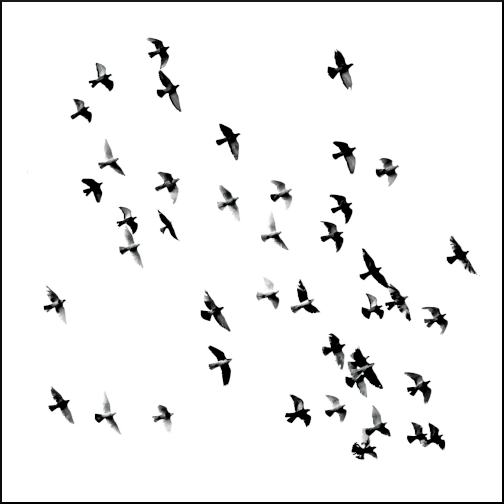
The birds of the world get together to decide who should be their leader. One suggests that they consult the Simurgh–which is a bird that had seen the destruction of the world thrice over and accumulated all the knowledge of the ages in the process.
The challenge is that the Simurgh can only be reached by crossing seven valleys. And, to get through, they will have to make a lot of sacrifices–giving up some of their comfort, pride, assumptions, and so on.
Based on this description, many birds fail to embark on the trip. And, of those that go, most reach a point where they are unwilling or unable to make the adaptations necessary to continue.
In the end, just 30 birds make it to the home of the Simurgh. Once there, they realize that they–in fact–are the Simurgh. As it turns out, the world “Simurgh” is a combination of the Persian words “si” (30) and “murgh” (birds).
In short, they were looking for an enlightened figure on whom the community could rely. And, by making the sacrifices that this search required, they became enlightened figures on whom the community could rely.
This message hit me hard for two reasons:
On an emotional level, I was fresh out of school and embarking on my own journey into unknown territory. So, I felt an unusual kinship with this gang of fictional birds.
On a practical level, it changed my perception of the work ahead of me. Specifically, I’d been operating under the impression that I was going to create opportunities for myself by learning new things. That’s part of the reason I was rooting around in a dumpster for books in the first place.
But after I read this poem, I started to realize that what I gave up could be as important–if not more important–than what I gained.
I hope this makes sense.
Prior to finding this poem, I’d been thinking that the person I wanted to be was basically the current me plus some new ideas and skills. But, after reading the poem, I started wondering if the person I wanted to be was actually the current me minus some of my assumptions and attachments.
In hindsight, I needed to work on both fronts. But, this poem really helped me understand–and embrace–the latter challenge in ways I had not even considered before.
With all this in mind, let’s talk about workout music.
For years, I’ve been mulling different projects based on The Conference of the Birds. It was clear from the outset that I wasn’t going to improve the tale, but I wanted to see if I could translate it to a different medium.
In particular, its message is one I want to keep top of mind. And, music is a natural medium for that sort of reminder–as folks are more likely to listen to a song they’ve already heard than read a book they’ve already finished.
Just in the last few months, I finally came up with a viable way to do this. And, the result is a new workout album: 30 Birds.
On the practical front, it’s an hour long mix that clocks in a 160 BPM–which makes it ideal for running, cardio, and so on.
In keeping with the background of the poem, the music is focused on Eastern percussion. And, to mirror the narrative, it begins with a large group of instruments–most of which drop out as the mix progresses.
Thematically, I thought this would mirror the birds’ journey–which also begins with many and ends with few. But, in the course of working on this project, I discovered a parallel I hadn’t considered.
Namely, I was trying to arrange a piece of music would follow the arc of the poem. And, I was trying to keep the tempo brisk so that folks could use it in a workout. To those ends, I thought a lot about the relationship between the music and the poem and between the music and a workout. But, I didn’t think at all about the relationship between the poem and a workout.
And, somewhere in the middle of the project, I realized that the poem follows the same arc as my most rewarding workouts. By that, I mean that I have workouts where I find myself moving faster or lifting more, but that’s sort of a fleeting thrill.
The workouts I value most are the ones where I feel overwhelmed–with thoughts or tasks or what have you–most of which fall away once I get moving.
Do you know this feeling? Where you set yourself in motion with what feels like a 100 things on your mind–unsure where to even start? And, over the course of a 30 minutes, you realized that there are probably five things that actually need your attention and 95 that don’t matter?
I’d love to say that I understood this about myself and my workouts and set out to create a mix that matches that dynamic, but–much like finding The Conference of the Birds in a dumpster all those years ago–it was a happy accident.
I know this a lot to read. But this idea–that we are shaped as much by the things with which we part as we are by the things we acquire–has been transformative in my life. And, for better or worse, I probably write in proportion to the impact I’ve felt.
With that in mind, I’ll wrap this up.
As a parting thought, this has been a particularly rewarding project because it caught me so off guard. I assumed that–since I’d been tinkering with it for so long–I would just be taking the lesson I’d already learned and moving it to a different medium. Instead, it’s become clear that I have almost as much to learn from these birds now as when I first encountered them.
And, that’s been thrilling and humbling in equal measure. So, thanks for allowing me to carry on about it.
I know not everyone will share my feeling that there’s a lovely and surprising overlap between the work that lies ahead of each of us, the sense of clarity that can accompany a great workout, and this old Persian poem.
But, if you’re open to that possibility, the 30 Birds album should make for a fine companion–as it follows the same arc in sound.
And, you can download it here.
Thanks!